
Beyond Sight – Elucidating the Non-visual Consequences of Ocular Diseases
The eye is not just an extension of the brain. It’s a window to neurological health and a complex organ that, through intrinsically photosensitive retinal ganglion cells (ipRGCs), drives and modulates many non-visual cerebral functions such as circadian entrainment, cognition, alertness, sleep, and mood. Beyond vision, ocular diseases like glaucoma and diabetic retinopathy can alter the non-visual signaling between the eye and the brain, leading to various impairments in non-visual functions and reducing the patient’s quality of life. Our goal is to translate fundamental findings in visual neurosciences into implementable screening and therapeutic interventions.
Altered Non-visual Photoreception in Patients with Glaucoma: Impacts on Sleep, Alertness, Mood, and Cognition.
Glaucoma, a leading cause of irreversible blindness worldwide, affects a class of photoreceptors (ipRGCs) involved in the entrainment of circadian rhythms, acute suppression of melatonin, pupillary light response, photic regulation of mood and sleep, and alertness. The objective of this study is to evaluate associations between non-visual photoreceptors and sleep, mood, alertness, and cognition in patients with glaucoma. Furthermore, we aim to evaluate the efficacy of a refined environmental lighting intervention to alleviate sleep, mood, alertness, and cognitive dysfunction in these patients. By addressing non-visual consequences and developing targeted interventions, this study aims to enhance the overall wellbeing and quality of life for patients with glaucoma.
Led by Daniella Mahfoud (PhD Student)
Optimizing Light Exposure to Improve Alertness and Cognition in Young Healthy Adults

Light is essential not only for visual perception but also for regulating various physiological and behavioral processes in humans. In the current increasingly urbanized and indoor-centric lifestyles, understanding the relationship between lighting and these components of human functioning is very important. This study aims to investigate the efficacy of controlled, intermittent exposure light on sleepiness, alertness, mood, and cognitive functions in young adults. The findings of this study will contribute to a better understanding of how lighting conditions can enhance the overall well-being. This could lead to broader applications for clinical populations dealing with sleep disorders, mood disorders, and cognitive impairments.
Led by Daniella Mahfoud (PhD Student)
Developing novel handheld and AI-driven devices for ocular and neurological disease detection
Evaluating the performance of handheld pupillometry for the detection and classification of eye diseases in the community

The evaluation of the pupillary light response using pupillometry allows for an objective assessment of photoreceptor health in retinal and optic nerve conditions. Our team at the Singapore Eye Research Institute (SERI) has developed an affordable and easy-to-use handheld chromatic pupillometer (HCP) that relies on contemporary findings in retinal photoreception and machine learning, to allow a fast (1 min), affordable, and accurate detection of ocular diseases. The HCP has recently shown excellent performances for the detection of glaucoma (even in the presence of high myopia), diabetic retinopathy, and retinal dystrophies in a clinical setting. In this project, we will evaluate the usability and efficacy of HCP for the detection of ocular diseases in a community setting.
PhD Student and Research Fellow Positions are Available
Optimizing the lighting environment for better myopia-control
Myopia is a highly prevalent refractive error characterized by the blurred vision of objects when viewed at a distance. Myopia is projected to affect 50% of the world population by 2050 and is commonly due to excessive ocular axial growth leading to images being focused in front of the retina. Myopia is far more than an inconvenience and is associated with vision threatening ocular complications, such as glaucoma, retinal detachment, and neo-vascularisation. Epidemiological studies have shown that time spent outdoors is protective against myopia. This could be due to the increased brightness and unique spectral characteristics of sunlight that are generally lacking indoors. The Eye N’ Brain team is conducting research in animal models and humans to better understand the neurobiology behind light-driven myopia-control and develop tailored light therapy strategies for myopia prevention.
The Neurobiology of Photic Interventions for Myopia-Control
We have recently developed a state-of-the-art research facility for evaluating the impact of light (intensity, spectrum, timing and duration) on different animal models including chickens, guinea pigs, and non-human primate (NHP). The NHP model includes Rhesus and Cynomolgus Macaques and was successfully developed in collaboration with Professor Earl Smith and Dr Li-Fang Hung (University of Houston, USA) using custom-built 3D-printed helmets equipped unilaterally with a Bangerter occlusion foil. We are currently using this model to evaluate the chronic impact of intermittent high intensity light exposures on ocular growth, myopia development and ocular vasculature and structure using swept-source optical coherence tomography-angiography. Intermittent exposure to high intensity light is showing promising results in preventing the onset of myopia in NHPs. Our team is also investigating 1/ the synergetic impact of defocus interruption and high intensity light and 2/ the impact of spectrally tailored indoor lighting strategies on emmetropization and ocular growth and metabolomics in chicken models of form-deprivation and lens-induced myopia. The ultimate goal of the group is to translate findings in animal models into feasible light therapy strategies for myopia prevention. These projects are in collaboration with the departments of Myopia (Co-Heads: Prof Saw Seang Mei, A/Prof Audrey Chia), Ocular Imaging (Head: Prof Leopold Schmetterer), Ophthalmic Engineering (Head: A/Prof Michael Girard), and the Translational Preclinical Model Platform (Head A/Prof Veluchamy Amutha Barathi) at the Singapore Eye Research Institute (SERI).
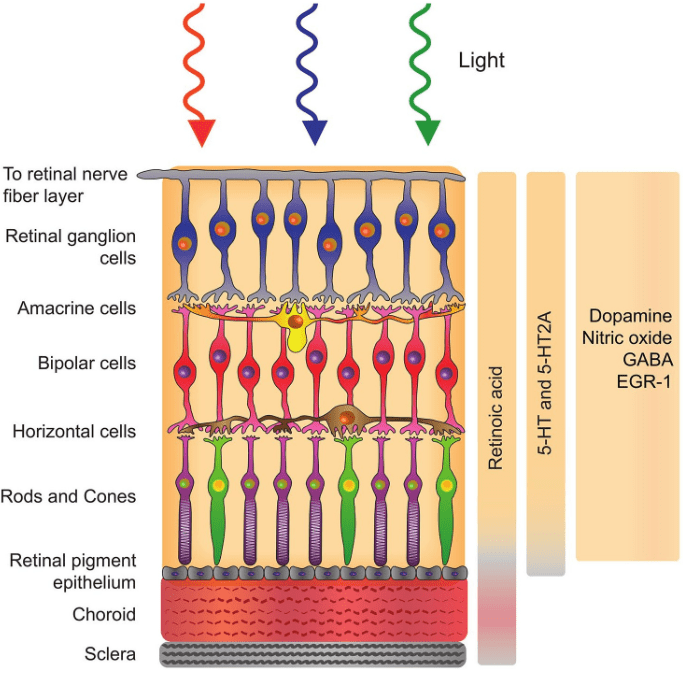
Figure from Muralidharan et al. 2021
Recent Findings:
We have recently reported that the spectral composition of white light can affect ocular growth and metabolomics. In a work published in Scientific Reports (Najjar et al. 2021) we evaluated the impact of moderate levels of ambient standard white (SW: 233.1 lux, 3900 K) and blue-enriched white (BEW: 223.8 lux, 9700 K) lights on ocular growth and metabolomics in a chicken-model of form-deprivation myopia. Compared to SW light, BEW light decreased aberrant ocular axial elongation and accelerated recovery from form-deprivation. Furthermore, the metabolomic profiles in the vitreous and retinas of recovering form-deprived eyes were distinct from control eyes and were dependent on the spectral content of ambient light. For instance, exposure to BEW light was associated with deep lipid remodeling and metabolic changes related to energy production, cell proliferation, collagen turnover and nitric oxide metabolism. This study provides insight on light-dependent modulations in ocular growth and metabolomics. If replicable in humans, our findings open new potential avenues for spectrally tailored light-therapy strategies for myopia.
Our team has also evaluated the impact of full-spectrum light-emitting diodes (LEDs) mimicking sunlight on ocular axial elongation and refractive error development in a chicken model of myopia and it was noted that compared to fluorescent lights moderate intensity (~285 lux) of Sunlike LEDs are capable of accelerating the recovery from form-deprivation myopia (Muralidharan et al., 2022). These studies also highlight an important role of the spectral content of white light in modulating emmetropization and ocular growth.
Furthermore, our group is also involved in understanding the synergistic effect of high intensity light (HL) and optical refocus (uncovered vision [UnV]) on myopia development using a chicken model of lens-induced myopia. Our latest findings show that the synergetic effect of HL light and UnV is dependent on the duration of the interventions, with only 6 hours of HL + UnV (not 2 or 4 hours) successfully preventing lens induced myopia (-10D) more effectively than UnV (P = 0.004) or HL (P < 0.001).
To learn more read Biswas et al., IOVS 2023
“Recovery From Form-Deprivation Myopia in Chicks Is Dependent Upon the Fullness and Correlated Color Temperature of the Light Spectrum”
Read the full article here
Building on these endeavors, our group is currently focusing on uncovering the signaling pathway from the retina to the sclera through the utilization of biomechanical analyses, transcriptomics, proteomics, and metabolomics.
 Eye N Brain